Beginner’s guide · September 23, 2026

Your vial says 10 mg. An example online says 500 mcg. Your syringe has numbers like 10, 20 and 30. How do those numbers fit together?
They describe different things. Once you separate the amount of peptide from the amount of liquid, the numbers become much easier to follow.
Start with two questions
How much peptide is there? That is usually written in mg or mcg.
How much liquid is there? That is written in mL. A U-100 syringe gives you another way to measure that liquid, using its numbered unit marks.
Think of sugar dissolved in water. A teaspoon measures the amount of liquid you scoop up. It does not tell you how much sugar is in it unless you know how sugary the mixture is. Peptide calculations use the same idea.
mg and mcg: two ways to write the amount
mg means milligrams. mcg means micrograms. Both measure the amount of a substance by weight; micrograms are the smaller unit.
1 mg = 1,000 mcg. So 0.5 mg and 500 mcg are exactly the same amount, written differently. [1]
- 0.25 mg = 250 mcg
- 0.5 mg = 500 mcg
- 1 mg = 1,000 mcg
- 10 mg = 10,000 mcg
To go from mg to mcg, multiply by 1,000. To go from mcg to mg, divide by 1,000. You may also see µg on a label; that means micrograms too.
For a single-ingredient dry vial labelled “10 mg,” that normally means the total amount of that ingredient in the vial. It does not mean 10 mg in every draw.

mL: how much liquid you have
mL means millilitres. It measures the amount of liquid, whether that liquid is plain water or a mixed solution.
Adding more water spreads the same amount of peptide through more liquid. It does not add more peptide.
The word concentration simply means “how much peptide is in each mL.” A label saying 5 mg/mL means every 1 mL contains 5 mg. A smaller draw contains a smaller share.
What do the numbers on a U-100 syringe mean?
A U-100 syringe is designed for insulin containing 100 insulin units per mL. That is where its numbering comes from. When reading that syringe as a volume scale, the number 100 means 1 mL. [2]
| U-100 mark | Liquid volume |
|---|---|
| 5 units | 0.05 mL |
| 10 units | 0.10 mL |
| 20 units | 0.20 mL |
| 50 units | 0.50 mL |
| 100 units | 1 mL |
Check that the syringe says U-100. These conversions do not apply to every syringe scale. Its maximum capacity also matters: a 30-unit syringe cannot hold a 50-unit volume.
“10 units” means the numbered 10 mark, not automatically the tenth little line. Check what the small divisions on your particular syringe represent.
Why 10 units can contain different amounts
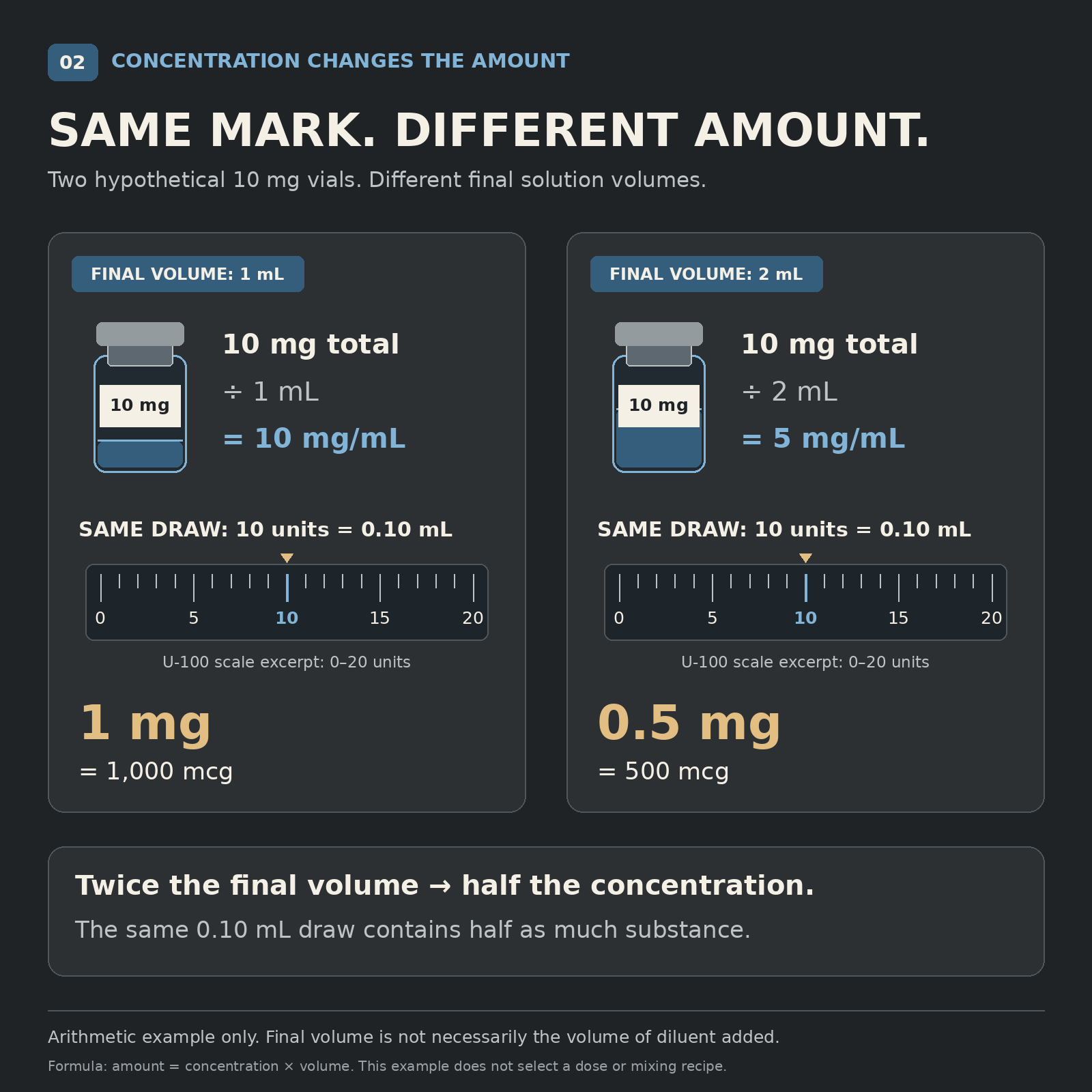
Here are two hypothetical vials. Each contains 10 mg total, but their final liquid volumes are different. “Final volume” means all the liquid after mixing, which is not necessarily identical to the amount of water added.
| What you are comparing | Vial A | Vial B |
|---|---|---|
| Total peptide | 10 mg | 10 mg |
| Final liquid volume | 1 mL | 2 mL |
| Peptide in each mL | 10 mg | 5 mg |
| Volume at the 10-unit mark | 0.10 mL | 0.10 mL |
| Peptide in that draw | 1 mg (1,000 mcg) | 0.5 mg (500 mcg) |
Vial B has twice as much liquid holding the same 10 mg. Each small draw therefore contains half as much peptide.
That is why copying someone else’s syringe number can give you a different amount, even if you both have the same peptide. The vial amount and mixing volume have to match too.
A simple worked example
Finding the mark for 500 mcg
Suppose the vial contains 10 mg in a final volume of 2 mL. For this maths example, we want to find the volume containing 500 mcg.
- Find how much is in 1 mL: 10 mg ÷ 2 mL = 5 mg per mL.
- Use matching units: 500 mcg = 0.5 mg.
- Find the liquid volume: 0.5 mg ÷ 5 mg per mL = 0.10 mL.
- Read the U-100 scale: 0.10 mL is the 10-unit mark.
If that same 10 mg were in a final volume of 1 mL instead, 500 mcg would be at the 5-unit mark. The amount you are measuring stays the same; the liquid volume changes.
These are arithmetic examples, not suggested doses or instructions for how much water to add to a product.
HGH IU: another meaning of “units”
With HGH, you may see IU, which stands for International Units. It describes the hormone’s biological activity—think of it as the product’s activity rating. It does not measure liquid volume. [3]
So 10 HGH IU and the 10-unit syringe mark are not interchangeable. To connect them, you need to know how many HGH IU are in each mL of the mixed solution.
For example, a hypothetical solution containing 10 IU per mL has 1 IU in 0.10 mL. That 0.10 mL is the 10-unit mark on a U-100 syringe. Change the IU per mL and the amount at that same mark changes too.

Let the calculator handle the arithmetic
For a dry peptide vial, have these details ready:
- The total amount in the vial, usually in mg.
- The mixing volume, following the product’s instructions. If the product gives a final concentration, use that as your check.
- The amount you intend to measure, with its unit clearly stated—mg or mcg.
- Your syringe scale and capacity.
Enter those details into the calculator and check both the mL result and the syringe mark. If you change the vial strength or mixing volume, calculate again. Do not reuse a saved unit number from a different mixture.
For a liquid product already labelled in mg/mL, you already have its concentration. You do not need to invent a mixing volume. The TRT calculator works from that labelled strength.
Three easy mistakes to avoid
- Mixing up mg and mcg. 500 mcg is 0.5 mg, not 500 mg.
- Using the vial’s size as its liquid volume. A container that can hold 3 mL does not necessarily contain 3 mL.
- Saving only “10 units.” Keep the vial strength and mixing details with the number so you know what it means later.
If someone gives you only a syringe number, the useful follow-up is: “What is in the vial, how much is in it, and what is the concentration after mixing?”
Using a reusable pen? Read the pen cartridge replacement guide. Pen dial markings and click volumes are device-specific; a U-100 syringe conversion does not establish a pen’s delivery volume.
Need help with the mixing itself? Read the mixing and storage guide. For a vial containing several ingredients, see the peptide blend worked example.
Sources
- NIST: metric prefixes — the relationship between milli- and micro-.
- DailyMed: U-100 insulin labelling — 100 insulin units per mL and matching U-100 syringes.
- National Cancer Institute: International Unit — what IU measures.